|
In 1991 Billy and Akaisha Kaderli retired at the age
of 38. Now, into their 4th decade of this
financially independent lifestyle, they invite you
to take advantage of their wisdom and experience. |
|
Retire to
Chile, South America
A Quick
Cultural Guide for Expats
A Snapshot View, Part I
by Retirees Mark and John

Million Dollar
view from the deck When we selected
Chile as our retirement destination, we had considered a number of other
countries, before making this our final choice. There may be more
affordable places to retire, like
Chapala,
Mexico and places in
Thailand or
Guatemala,
however the stability and the quality of life that we achieve in Chile
makes the extra expense worthwhile.
Country
Overview
Chile has a
diversity of climates and you can experience a world of travel without
crossing a border. Ranging from the Atacama Desert to the North,
through the temperate central regions, the picturesque and almost
European feeling of upper Patagonia, to the extreme ruggedness of the
far South – it is impossible to say
you’ve ‘done’ Chile without spending a number of months in the country. The economy is primarily driven by extractive industries, especially
copper & gold, and secondary but important industries include
agriculture, viticulture, and tourism.
The Adventurer's
Guide to Early Retirement, 5th Edition
A Common Sense Approach
Politically, Chile
has been the textbook success story of moving into a democracy, and
recently joined the OECD (Organization for Economic Co-operation and
Development). It is a safe country these days, with some of the lowest
crime rates in the world.
Real Estate
Insights
Our version of
early retirement included buying a home. The good news about Chile is
that property prices are an excellent deal for the average North
American planning to retire, and your investment in real estate is
secure. We bought a 2500 sq ft home with a million dollar view
overlooking the beach in a small coastal community about one hour from
Santiago, for $160,000 USD.
Property prices have increased somewhat
since we bought in 2009, but a turnkey, well-built home in a small
coastal community is readily available for around $200,000. The only
difference from buying a home in the US or Canada was the legal and
closing costs – which were a bit higher than we were accustomed to. One
must budget $7 - $8 thousand dollars for this part of the housing
transaction.
If you would
prefer to rent, our neighbor rents his 3 bed 2 bath beach house for $850
USD a month. And if you don’t need the beach view, prices for non-view
homes just a couple of blocks behind our home, are less than $100,000 –
in some cases, around the $50k mark.
All of our books lead
to adventure. Don't miss out on yours!
Taxes
Taxation in Chile
is largely consumption based. There is a well-established Value-Added
tax of 19% on everything you purchase. Furthermore, you’ll notice a
number of ‘user fee’ or ‘pay as you go’ types of taxes – such as road
tolls on the very well-built freeway system. The payoff, however, is
that income taxes are next to zero. As a new Chilean resident, you are
granted a generous multi-year exemption, and the situation after this
grace period is extremely manageable.
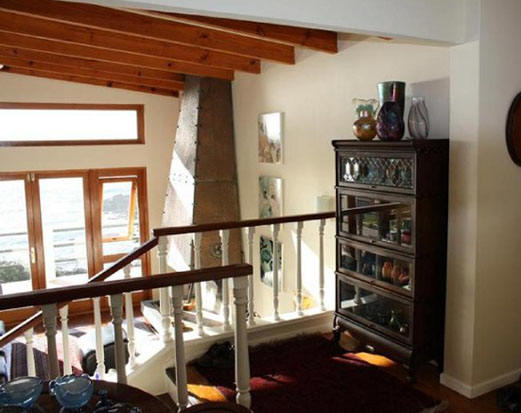 Outstanding home
for $160k USD The Health Care
Question
Medical care in
Chile is world-class.
A robust ‘full
service’ insurance coverage for the two of us, costs about $350 US a
month. The quality of the care itself is extremely high. A typical
Chilean physical exam includes the usual tests, but also an ultrasound
of one’s organs, plus a chest X-ray. As Canadians used to Canadian-style
medical care, we find the quality of care we receive here in Chile to be
superior.
Day-to-day
Living
While we live in a
relatively rural setting in a town of only 15,000 residents, we have
access to all modern conveniences. Chilean produce, fresh fish, meat and
poultry are abundant and very reasonably priced. You probably are used
to seeing Chilean produce in your local supermarket - rest assured that
there is even better and tastier produce available locally!
And if you enjoy
wine, then you’re in for a real treat as the rebounding Chilean wine
industry is producing remarkably high quality product at very reasonable
prices. Again – the export market for Chilean wine is developing, and a
lot of the best bottles aren’t reaching North American shelves!
We gave you the
pros, now here are the cons
Cost of Driving
One downside of
living in this country is the cost associated with driving. Chile has a
prohibition on the import of used vehicles, so expect to pay a small
premium for new & used vehicles when you arrive. The vehicle we
purchased here for $18,000 USD would have cost about $15 - $16,000 in
Canada/US.
The Adventurer's Guide to Destination Choices
Chile doesn’t have
any oil deposits, so gasoline is more expensive than in North America
too. Currently it is about $1.60 a liter as compared to $1.25 a liter in
Canada. Spare parts are limited in supply and sell for a premium, so
expect to be purchasing parts online and having them shipped. Recently
I had to replace a headlight assembly for my Nissan. From the local
dealer, the part was $525, but I was able to find it online for $160,
plus $40 shipping.
Earthquakes
For those of you
living in California, dealing with the threat of earthquakes is nothing
new. The major 2009, 8.8 quake that hit Chile was a disaster. However
the homes that were affected were, by and large, not the sorts of homes
that would be considered by retirees. Most of the horror stories
involved homes built in the tsunami zone, and were not generally built
to specification. Our home was basically unaffected in the quake. We
had 6 pictures fall off the wall, and one stone block lift in the
driveway.
Chileans
understand the earthquake risk, and build accordingly.
Spectacular Chilean sunset
Sample Monthly
Budget
Here is a sample budget for one month’s expenses
for two adults:
Medical insurance: $350
- Electricity: $100 - Internet/TV/Phone/Alarm: $125 - Fuel for car: $300
- Water: $25
Food: $1000 - House & car insurance: $150
- Entertainment: $300 - Home/vehicle repair & maintenance: $250 Clothes: $100
- Propane: $75
Annual/periodic expenses: Property tax = $200
a year. Fees to community association: $1000.
Based on our
experience of living extremely comfortably in Chile, with a superb
quality of life, one should budget approximately $3000 a month. We allow
ourselves $14,000 a year for travel so our annual retirement outlay is
around $50,000.
If these amounts
are within your means, then Chile may make sense for you!
Do you have questions about Visas,
Banking, Postal Services, Transport, Cost of Living?
Read Part II
 Mark and John on
the beach in Chile
About the Authors
Profile of Mark and John
Mark has extensive experience in leading international tours with a
background in retail and sales. In 2005, he ran a local NGO focused on
women’s empowerment through small business development in Afghanistan.
John has a public service background for a large government ministry in
Canada and found himself in various foreign countries such as East
Timor, North Korea and then Afghanistan.
In 2010, they decided to retire to Chile to live simply but without
compromising on quality. One of their values was to retain the freedom
to travel while having a home base.
We would
like to thank both Mark and John for sharing this insight into Chile
as a fascinating retirement destination. We have never traveled to
Chile, so cannot vouch for the accuracy of this information.
However, if you have any questions about retiring to this
captivating country, we are happy to pass them on.
For more on
Retirement Topics,
click here and
here and don't forget to signup for
our free Newsletter.


About the Authors



Retire
Early Lifestyle appeals to a different
kind of person – the person who prizes their
independence, values their time, and who doesn’t
want to mindlessly follow the crowd.
HOME
Book Store
Retire Early Lifestyle Blog
About Billy & Akaisha
Kaderli
Press
Contact
20 Questions
Preferred
Links
Retirement
Country Info
Retiree Interviews
Commentary
REL Videos
|